 |
| T. E. Lawrence (Peter O'Toole) becomes a legend with his victories against the Ottoman Empire - but loses himself in the process. |
Release Date: Dec. 10, 1962. Running Time: 227 minutes (restoration). Screenplay: Robert Bolt, Michael Wilson (originally uncredited). Based on the book, Seven Pillars of Wisdom, by T. E. Lawrence. Producer: Sam Spiegel. Director: David Lean.
THE PLOT:
During the First World War, Lieutenant T. E. Lawrence (Peter O'Toole) is serving in Cairo, where this fey and overeducated young man is a misfit who is barely tolerated by his superiors. He is given the chance to escape his dingy work by the Arab Bureau's Mr. Dryden (Claude Rains), who tasks him with observing and assessing Arab Prince Faisal (Alec Guinness)'s rebellion against the Ottoman Turks.
Faisal's situation is grim. More and more of his troops are deserting in the wake of a brutal defeat. Col. Brighton (Anthony Quayle), the official British army liaison, is urging him to fall back to the city of Yenbo, where his remaining men will be placed under British control. Faced with the dissolution of his army, Faisal has no choice but to agree. "To be great again, it seems that we need the English... (or) we need a miracle."
Lawrence decides to provide that miracle. With fifty troops led by Faisal's ally, Sherif Ali (Omar Sharif), he determines to cross the desert, win Arab allies, and attack the Turkish-held port of Aqaba from the land, behind the Turkish guns.
This bold plan works, and Lawrence is hailed as a hero by the British and as something akin to a prophet by the Arabs. But to Dryden and Gen. Allenby (Jack Hawkins), the head of the British Army's Egyptian Expeditionary Force, he is a tool to defeat the Turks - and to be discarded once his usefulness is over...
 |
| Prince Faisal (Alec Guinness) takes Lawrence's measure. |
CHARACTERS:
Lawrence: This was not Peter O'Toole's first film role, despite the "introducing" credit, but it definitely was his breakout performance. Lawrence is idealistic at the beginning. He's appalled when Sherif Ali kills his guide for drinking at the wrong well, an act Lawrence denounces as "barbarous and cruel." Later, circumstances force him to execute a man whose life he had saved earlier, which shakes him - in part because this undermines his claim that "nothing is written"; but also in part because, as he later admits, he enjoyed killing. This is a mid-film hint that there's something dark inside him, and that darkness ends up emerging near the end in one of the movie's most unforgettable moments.
Prince Faisal: Alec Guinness plays the Arab leader as a cautious man, someone who knows he's dealing with vipers and carefully measures his every word as a result. He takes the measure of Lawrence in their first encounter, both intrigued and wary of the younger man's love of Arabia. "No Arab loves the desert. We love water and green trees. There is nothing in the desert, and no man needs nothing." He all but goads Lawrence into making the decision to attack Aqaba without ever once actually asking him to do anything. Later, when he learns that Dryden and Gen. Allenby have made a power-sharing agreement with France, Faisal compliments them on their deception. Eventually, even Allenby is taken aback by Faisal's ability to use situations and people. Faisal replies that it's a matter of necessity: After all, he must become a king.
Ali: Egyptian-born Omar Sharif was already a successful actor in his home country when he made his English language debut in Lawrence. Ali is a composite of multiple people Lawrence worked with, and he emerges as the heart of the movie. He initially distrusts Lawrence, but he is converted into an admirer during the campaign on Aqaba, ultimately becoming Lawrence's only true friend. Sharif's performance is highly effective, particularly in the final hour when Ali is left to helplessly witness Lawrence's transformation into a colder, more brutal man. When Lawrence returns to the desert, Ali relates to reporter Jackson Bentley (Arthur Kennedy) that Lawrence "offered me money," all but crying at the insult.
Auda Abu Tayi: The movie's most straightforward character, played by Anthony Quinn as an enthusiastic bandit king. He and Ali despise each other because of tribal rivalries, and Auda is violent and short-tempered. Still, he's always honest about what he's thinking. When Col. Brighton reacts with disgust to the Arabs looting and then going home, Auda sums the situation up succinctly: "When Lawrence has got what he wants, he will go home. When you've got what you want, you will go home." In macro terms, it's hard to argue - though Brighton tries.
Dryden: Claude Rains is wonderful as always in what may have been his last "great" role. Dryden is another composite character, essentially standing in for all the politicians involved in the war in the Middle East. Even in these early scenes, it's clear that his Arab Bureau's interests don't align with those of the actual Arabs. His focus is very much on the postwar allocation of power. He's pleasant and charming, but he's not even a little bothered by his own ruthlessness, justifying himself to Lawrence by saying: "A man who tells lies, like me, merely hides the truth, but a man who tells half-lies has forgotten where he put it."
Gen. Allenby: In contrast to Jack Hawkins' larger-than-life characters in The Bridge on the River Kwai and Ben-Hur, his Allenby is extremely life-sized. Allenby and Dryden use Lawrence for his abilities and influence among the Arabs, but Allenby takes no responsibility for the unsavory parts of his job. Variations of, "I'm a soldier" and "I have my orders" are all but catchphrases. This makes him an even more distasteful figure than Dryden. The one-time Lawrence confronts Dryden with his deceptions, he owns up to them; Allenby sits in a chair practicing fly fishing techniques while a nearby city burns, and he never once takes the slightest responsibility.
Col Brighton: A straightforward man - ironically more like Auda, who calls him a fool, than like Allenby and Dryden, who confide in him. He dislikes Lawrence, but he shows respect for his victories. At Lawrence's funeral, he is the only person to simply say that he knew Lawrence, with neither self-promotion nor reference to his accomplishments. Quayle gets an outstanding moment of nonverbal acting near the end. Brighton is in the room to witness Faisal, Allenby, and Dryden arguing over the distribution of power as if haggling over the price of vegetables. It's clear from the start how bothered he is. But as the cold-blooded comments pile up, his face starts to show a growing sense of pure revulsion. Impressively for a movie filled with quotable dialogue, the film recognizes that Brighton's face says all, and that words are unnecessary.
Turkish Bey: José Ferrer delivers one of the all-time great single scene performances, as a Turkish commander who captures Lawrence without ever knowing the value of this prisoner, merely abusing the fair-skinned young man to satisfy his own appetites. It's a key moment, one that changes Lawrence completely. Though you can count Ferrer's lines on your fingers, he is mesmerizing. I love the end of the scene, where he huddles in a doorway, coughing - a small man who has power because of his position, drinking in the spectacle of his guards savagely beating Lawrence.
 |
| The Turkish Bey (José Ferrer) abuses the captive Lawrence for his own amusement. |
THOUGHTS:
"Nothing is written."
-T. E. Lawrence (Peter O'Toole) insists on attempting the impossible. It will eventually catch up with him.
If you've read T. E. Lawrence's Seven Pillars of Wisdom, then you can immediately appreciate how hard it must have been to adapt it into a movie. It's a dense work and, though it's well written, it's also often a difficult read, filled as it is with names and titles, dates and incidents.
Michael Wilson had co-written director David Lean's previous movie, The Bridge on the River Kwai, and he took the first crack at the script. According to Gene D. Phillips's Beyond the Epic: The Life and Films of David Lean, Wilson's draft created the basic structure, along with many of the composite characters. However, Lean felt it was too focused on the politics of the Arab Revolt. Robert Bolt was brought in to shift the focus to Lawrence the man, rewriting virtually all of the dialogue in the process (the story is essentially Wilson; all those great lines are mostly Bolt). Robert Bolt was the sole credited screenwriter until 1995, when Michael Wilson's name was restored to the credits as co-writer.
Regardless of behind-the-scenes drama, the final script is outstanding. A prologue chronicles Lawrence's death and his funeral, with several characters glimpsed at the funeral. It's interesting to re-watch this after the movie, as their individual reactions are telling once you know their respective roles in the story. Even on first viewing, the scene establishes Lawrence as a brilliant figure, but also a remote one. "I didn't know him" is a frequent refrain.
The movie is neatly divided into two parts. The first two hours create an adventure story, with Lawrence's journey into the desert leading to his triumph at Aqaba. He faces adversity and resistance. The desert crossing is brutal, particularly an area Ali dubs, "the sun's anvil." Events conspire against his insistence that "nothing is written" when he is forced to execute a man he rescued from the desert. Even after the victory, on his way back to Cairo, he is unable to save another ally - his first failure in the movie, and a memorable moment. Still, most of the first two hours is about his rise, with him returning to Cairo to a hero's welcome.
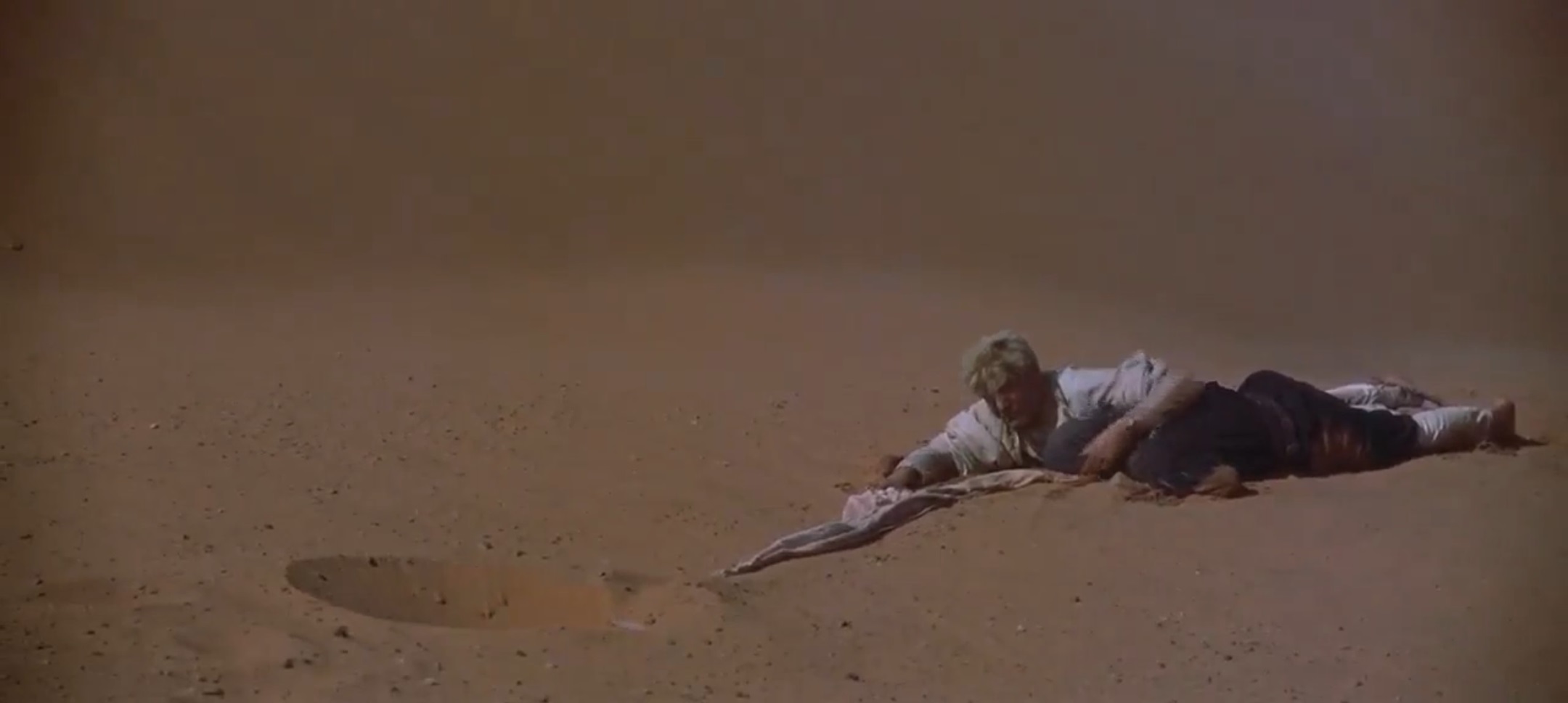 |
| Lawrence's first failure, as he's helpless to save an ally from quicksand. |
Still, those moments of powerlessness are a harbinger of things to come. Just before the Intermission, there is a sharp tonal shift. Allenby and Dryden have convinced Lawrence to return the desert, promising him all the assistance he and his Arab allies need. As they walk away, however, the general and the politician agree that they have no intention of keeping their word. Allenby invokes his catch-phrase, thanking God that he's a soldier with orders to follow, before observing that Lawrence is "riding the whirlwind."
After the intermission, we begin watching Lawrence's fall. Hubris leads him to the Turkish Bey, and he is emotionally shattered by the result. When he returns to the desert for a final "big push," he comes with bodyguards, there to keep him from being hurt again. The Lawrence of the first half would have mocked the very idea of such a precaution - but that Lawrence had not yet been "humbled," as Ali puts it.
Before the Bey, Lawrence was careful to make sure that Turkish prisoners were treated fairly. After the Bey, he no longer sees the Turks as human. Ali witnesses a bombardment and gasps, "God help the men who lie under that." Lawrence shrugs off the sentiment, coldly stating, "They're Turks." All of this builds to his final military order in the film, in which ideas of mercy are thrown to the wind over Ali's objections. The two first met with Lawrence aghast at Ali's callous first action; in the end, however, it's Ali who is appalled by what Lawrence has become capable of.
 |
| Ali's introduction: From a speck on the horizon to a major figure in the story. |
TIME SUSPENDED - VISUALS AND EDITING:
Lawrence of Arabia is a very long movie. In its restored version, it runs 227 minutes (including intro. music, Intermission, and exit music), making it slightly longer than Ben-Hur and only a little bit shorter than Gone with the Wind.
The time doesn't go by quickly, not exactly. It's more that time seems to stop passing. If you ever have the opportunity to see this in a theater - DO! The passage of time seems to suspend once the lights go down. When they come back up, you're left wandering, semi-disoriented, into the theater lobby, with reality seeming just a little less real for a few minutes after.
A lot of this comes from the movie's technique. It's a David Lean epic, so it goes without saying that it's visually remarkable. But it's also very different in style from The Bridge on the River Kwai. Many shots are from far away, with the characters little more than specks on the horizon. Some scenes will deliberately cut away from close action to more distant shots, just to emphasize the vastness of the desert and just how tiny all these people are within it. Shots are also held to show distances. A character doesn't simply walk or ride up to another character to speak; the camera will hold on him as he closes the distance before speaking.
A notable example of this is Ali's entrance. He appears on the horizon about 24 minutes into the movie, riding toward the spot where Lawrence and his guide are resting. It isn't until more than two minutes later that he actually reaches Lawrence. It's a remarkable introduction, one that leaves no doubt as to this character's importance in the narrative - and the visual presentation is downright hypnotic.
Film editor Anne V. Coates won an Academy Award for this movie, and with good reason. There are some striking cuts in this movie. There's the most famous one, of course, as the film cuts from Lawrence blowing out a match to our first sight of the desert as the sun rises (another sustained shot). But there are many other notable moments.
After Lawrence survives an attempt on his life during the capture of a Turkish train, he climbs onto it. The film cuts from his climb to show his shadow, moving across the train car. Then to his silhouette, with us unable to see his features. Then to his feet as he moves to climb down. A reporter asks to take his picture - but instead of showing him striking a heroic pose, the film stays on the reporter before cutting to the next scene. This emphasizes Lawrence's current state: He has started believing in his own legend. He may strike the hero pose, but the viewer is denied the sight of it, because he is already well into his fall.
 |
| Lawrence holds up a match, in one of the most famous transitions in film history. |
RESTORATION:
Lawrence of Arabia is a very long movie, and several abridgements were released over the years. After the movie's premiere, Lean was forced by producer Sam Spiegel to trim twenty minutes. Lean himself, feeling stung by accusations of overlength and self-indulgence, cut it back further for its 1970 re-release, to just over three hours. For a long time, the three-hour abridgement was the version available on television and home video.
In 1988, Lawrence of Arabia was restored to its original form... almost. David Lean supervised this restoration, whose staff also included original editor Anne V. Coats. The initial goal was to return it to its full length... but Lean couldn't resist making a few pacing trims. Most of these were restored for the 1989 re-release, but some lines of dialogue remained on the cutting room floor.
It's this version that's now the default version for DVD, blu ray, and streaming services. There may be variation in length between 222 and 227 minutes, depending on whether the full intro. and exit music is included - but the actual movie is the same either way.
INFLUENCE:
Lawrence of Arabia has received no direct remake, thankfully, but many directors have acknowledged its influence on their work, including Stanley Kubrick, Steven Spielberg, Ridley Scott, and Martin Scorsese. Kathryn Bigelow credited this movie with her choice to shoot The Hurt Locker in Jordan.
A 1990 BBC television film, A Dangerous Man: Lawrence After Arabia, portrays Lawrence's attempts at the Paris Peace Conference to win control of Syria for Prince Faisal. Worthy viewing, with Ralph Fiennes and Siddig El-Fadil quite good in the roles of Lawrence and Faisal. It makes a decent epilogue/complement to Lean's epic - but, like many early 1990s BBC historical films, it assumes a certain amount of viewer familiarity with the Paris Peace Conference, and it can be a bit... well, dry.
 |
| The march on Aqaba: An army of ants in the vastness of the desert. |
OVERALL:
In my review of David Lean's The Bridge on the River Kwai, I ended up awarding full marks. Lawrence of Arabia is, in my opinion, even better, possibly standing as Lean's masterpiece.
Stunning visuals, great acting, composer Maurice Jarre's incredible score, and a script so full of quotable lines that it might be quicker to list those that aren't memorable... Honestly, I could keep piling on superlatives, but to what end?
Lawrence of Arabia is widely regarded as one of the greatest movies ever made. And as is probably clear by this point, I'm not inclined to argue with that assessment.
Rating: 10/10.
Best Motion Picture - 1961: West Side Story
Best Picture - 1963: Tom Jones
Review Index
To receive new review updates, follow me:
On BlueSky:

On Threads:


